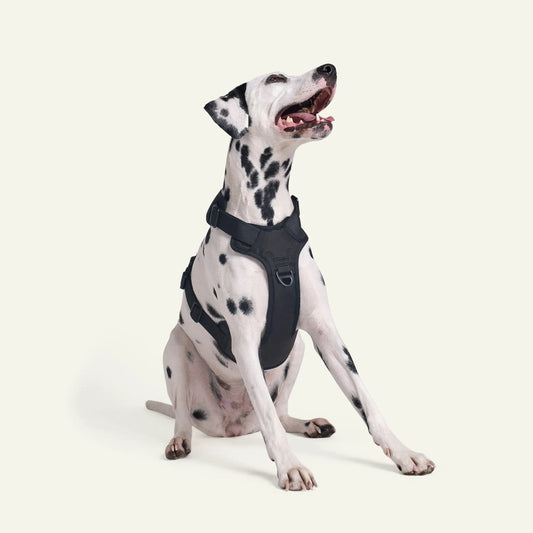
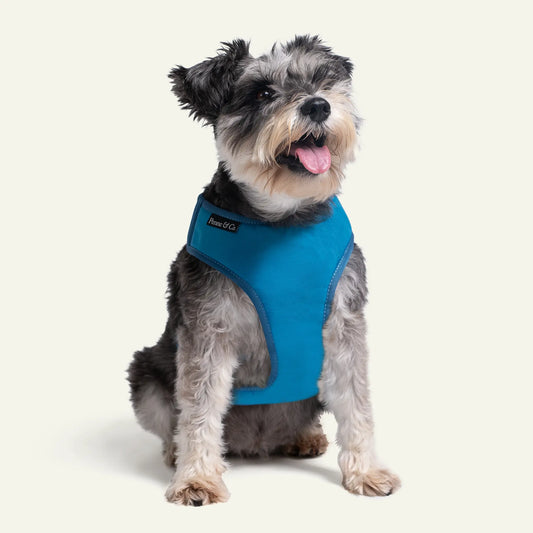
Choosing between a collar or a harness is one of the most important decisions you will make for your dog. The right choice affects their safety, comfort, breathing, and long-term health. Although both tools are common, veterinary research shows that they impact a dog’s body in very different ways.
This article breaks down the science, the pros and cons, and the situations where each option is suitable. All claims are supported by peer-reviewed papers and trusted veterinary sources to help you make the safest choice for your dog.

Dogs have delicate structures in the neck. These include the trachea, larynx, thyroid gland, cervical vertebrae, and major blood vessels. When a dog pulls, or when the handler accidentally jerks the lead, the collar absorbs the force directly in this area.
Multiple veterinary studies have raised concerns about this.
Key findings from research:
• A study by Pauli et al. (2006, Journal of the American Animal Hospital Association) found that pressure from collars can cause a significant increase in intraocular pressure, which is a risk for dogs prone to glaucoma.
• A study by G. Arnott et al. (2015, Journal of Veterinary Behaviour) showed that dogs respond more calmly and show lower stress signals when walked on a well-fitted harness compared to a collar.
• Research from Anders Hallgren, animal behaviourist and physiotherapist (2013), documented cervical injuries in dogs correlated with long-term collar use in dogs that pull.
These findings highlight a clear pattern. When force is placed on the neck, the risk of injury increases. Harnesses move that force to the chest and shoulders, which can handle load more safely.
Collars are traditional, familiar, and easy to use, but they come with safety considerations whilst harnesses distribute pressure across the chest, sternum, and shoulders. These are areas that are structurally designed to absorb movement and force. This makes them the preferred option for most walks.
Collar Pro's
Collar Con's

Harness Pro's
Harness Con's
A COLLAR CAN BE ACCEPTABLE FOR:
MOST GUARDIANS AND VETS AGREE THAT HARNESSES ARE SAFER FOR DAILY WALKS. THEY ARE PARTICULARLY IMPORTANT FOR:
You May Also Like
-
 BUNDLE & SAVE
 BUNDLE & SAVE
- Choosing a selection results in a full page refresh.
- Opens in a new window.