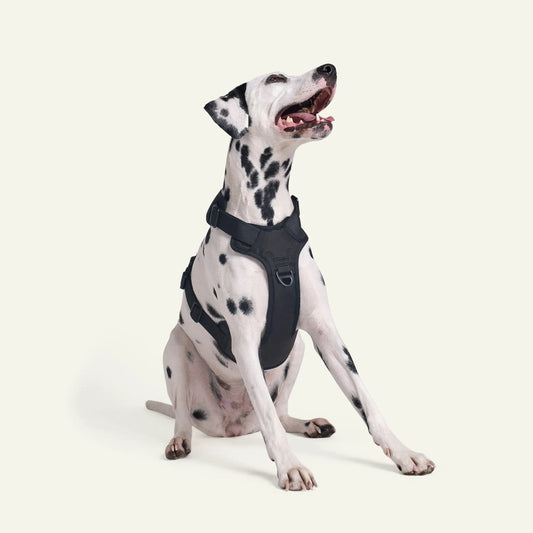
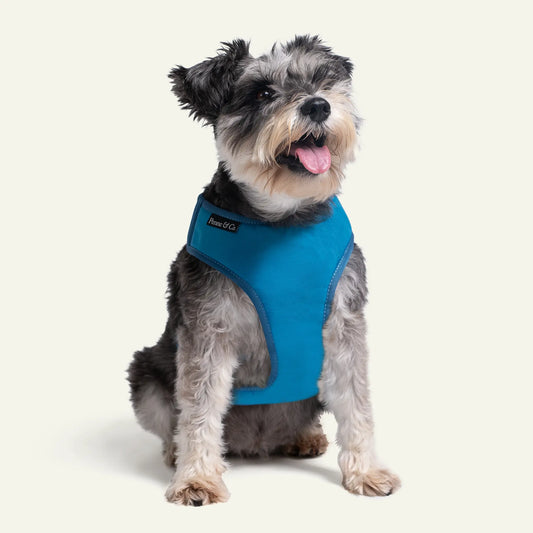
Your dog doesn't see colour like you do.
But what does this mean?
The age old claim that dogs are colour blind is not quite true.
Most of us see the world through the lens of a full spectrum of colours, vibrant, bright, and even dull and muted. Your dog however, doesn’t get the same freedom. You see, dogs' eyes are built differently, so certain colours stand out for them and others barely register at all.
Dogs have what is called yellow blue dichromatic vision. Humans have three types of cones in the eye which allow us to see reds, greens, and blues. Dogs have two, meaning that they see the world through a much narrower colour spectrum.
To your dog, blue, blue green, and even violet all look like different shades of blue. Yellows appear clear and bright. Reds and greens shift into darker browns and muted greys. A green toy on a green lawn might as well be invisible. You’ve probably noticed this whilst playing with them in the park or in the garden.
It’s not just colour which our dogs also have a harder time seeing. Their eye setup means that separating differences in brightness is also more challenging for them, so the world looks slightly more muted compared to how we see it.
While dogs lack colour detail, they excel in other areas. A dog's eyes have far more rods than ours, which means that they see movement far earlier and see better in low light. You’ve likely noticed your dog picking up the twitch of a bird or a rustle in the dark long before you had any idea something was there. Well that’s because their eyes are tuned to a different visual system, tuned to different priorities in order to provide them with the tools to both hunt and survive before we had them sleeping in our beds and eating from a bowl.
Because blue sits clearly within their visible range, it genuinely stands out for them. When I throw a blue toy for Penne, I can actually see the difference in how quickly he picks it up with his eyes. It does not disappear into the grass or blend into whatever else is going on around us. It holds its shape in his vision, which makes the whole game cleaner and more enjoyable for him.
Yellow works too, but blue cuts through the environment and is stimulating in a way that gives him the clearest view, especially outdoors. You can see it in the way he tracks it. There is no hesitation, no second of searching, no confusion about where it landed. It becomes a straightforward chase rather than a guessing game.
This is the sort of detail most people never think about, but once you understand how your dog sees colour, it changes how you choose toys. It becomes less about what looks nice to you and more about what is actually most interesting for them. For me, it is part of seeing the world through the guardian lens. You start noticing these little things that make their life easier, and it becomes second nature to choose the colour they can genuinely see.
Now you’ve got an understanding of why we designed our tennis balls the way we did. Our blue and yellow options are intentionally created to be the most visible for your dog. They are bright and easy for them to lock onto, especially during fast play.
We also include an orange ball. Orange sits closer to the muted end of your dog’s vision, which makes it a lower stimulation option for days when they do not need extra excitement but still want to play. A simple shift in colour lets you choose how energising the game should be.
Each ball is slightly firmer than standard versions, with reinforced stitching and tear resistant felt so they keep their shape during repeated throwing and chewing.